Automotive AI Readiness: Tesla Blocks, Volkswagen Publishes 198 Links
Published 2026-04-20 · PROGEOLAB Research
The Automotive AI Readiness scorecard ranks the 37 Fortune Global 500 companies in the automotive sector — automakers, truck manufacturers, and tier-one parts suppliers — on five AI-visibility dimensions: ChatGPT-User accessibility, llms.txt implementation, robots.txt AI policy, JSON-LD structured data, and security.txt publication. The sector spans 11 countries and includes German premium (BMW, Mercedes, Volkswagen), Japanese volume (Toyota, Honda, Nissan), Chinese EV (BYD, Geely, CATL), American legacy (Ford, GM, Tesla), and global parts suppliers (Bosch, Continental, Denso, Magna).
The sector produces the widest within-industry variance in the Fortune 500. At one end: Volkswagen (AI Readiness score 8) with the second-largest llms.txt in the Fortune Global 500. At the other: Tesla (score 0), blocking at the WAF layer so comprehensively that no user agent — research bot, Googlebot, Chrome, or ChatGPT-User — successfully fetches a single byte. Two companies often paired in market-share conversations, at opposite ends of AI visibility.
Tesla: the deepest block in the Fortune 500
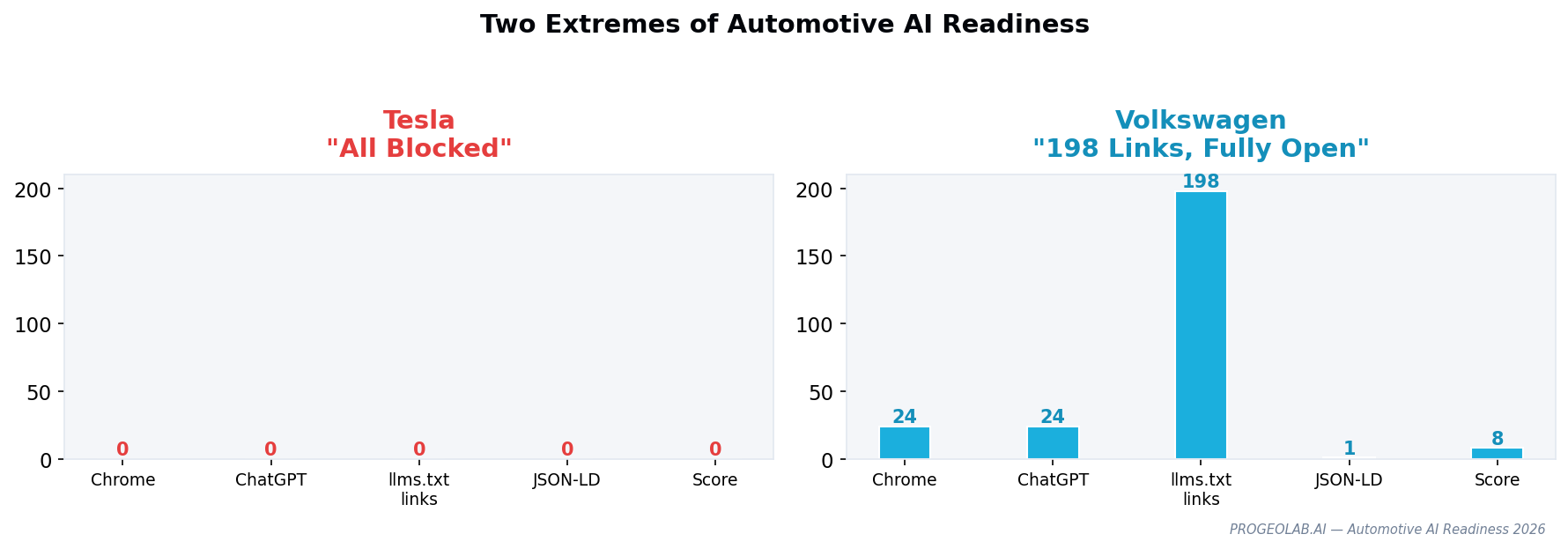
Tesla's probe results across all four user agents: 0/64, 0/64, 0/64, 0/64. Not a single successful HTTP response. The research bot, Googlebot, Chrome from a datacenter IP, and ChatGPT-User all receive connection-level rejection. This is not Layer 1 (User-Agent string) blocking — Tesla rejects every UA from the probe infrastructure. The block operates at Layer 2 (datacenter IP reputation) or Layer 3 (TLS fingerprinting).
Tesla's website is accessible from residential IP addresses but treats all datacenter traffic as hostile. When a consumer asks ChatGPT to compare Tesla Model Y with competitors, the AI cannot access tesla.com for current pricing, range, Autopilot features, or configurator options. It answers from training data — which may predate the latest model refresh, price cut, or feature release. Competitors with accessible websites (Hyundai, Kia, Volkswagen) are cited with current information.
Tesla's blocking posture is the deepest in the entire Fortune Global 500 dataset. It is more aggressive than Amazon's 16-bot blocklist (Amazon at least serves Chrome) and more thorough than Goldman Sachs (which allows the research bot even while blocking ChatGPT).
Volkswagen: the 198-link llms.txt
Volkswagen's llms.txt at vw.com contains 215 lines and 198 curated URLs — the second-largest in the Fortune Global 500, behind only Salesforce (205 links). The file organizes content across model ranges, dealer services, sustainability initiatives, corporate history, and investor relations. It is a comprehensive guide to everything on vw.com that an AI system would need to describe Volkswagen accurately.
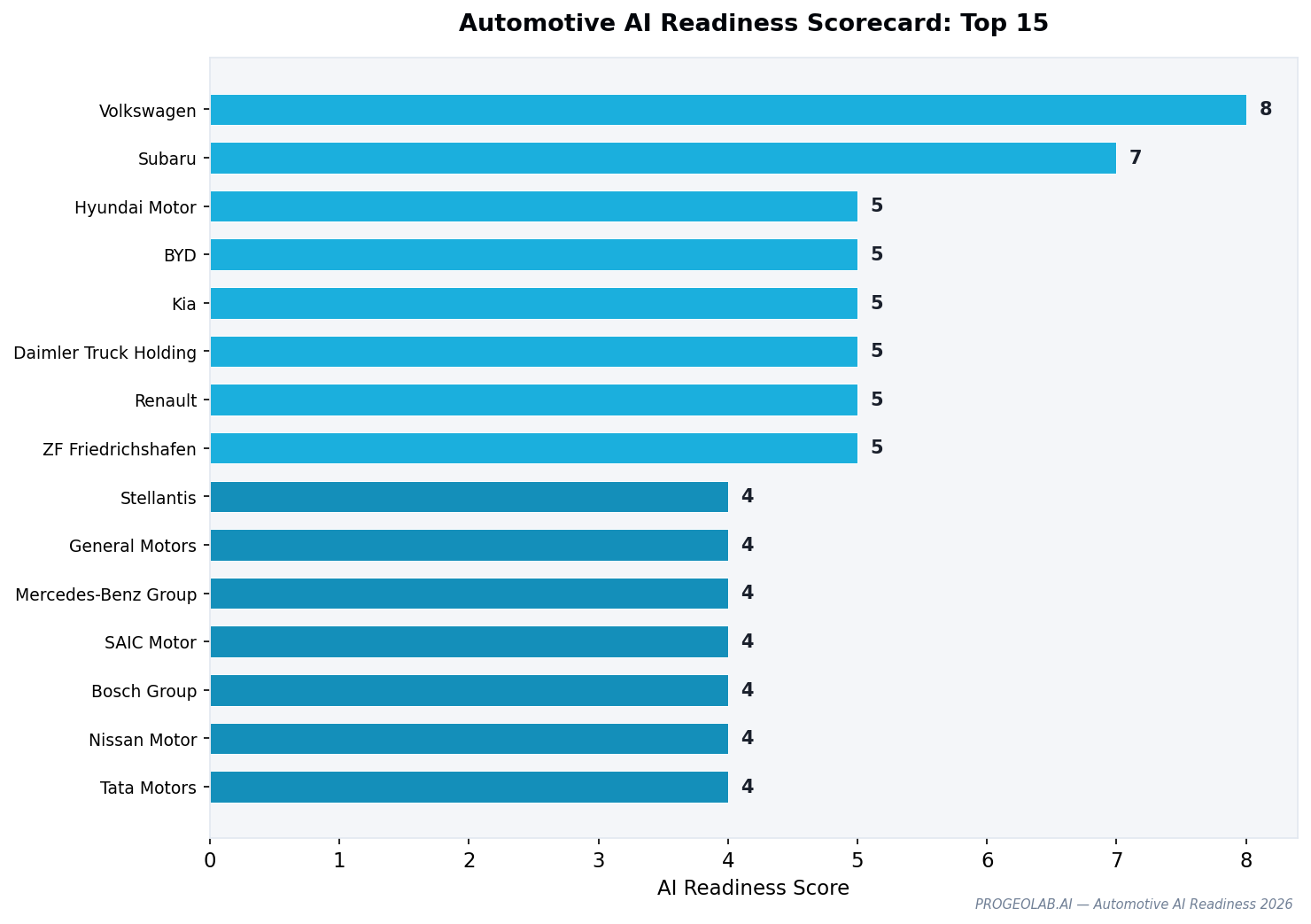
VW also scores well on the other dimensions: ChatGPT-User accessibility (24 of 64 endpoints), JSON-LD structured data, and F5 BIG-IP WAF configured to permit AI crawlers. VW's AI Readiness Score of 8/11 is the highest of any automaker, and higher than most tech companies. A traditional German automaker, founded in 1937, has a more AI-optimized web presence than Oracle, IBM, or Salesforce — a pattern documented in The AI Irony.
Subaru: the content-first overachiever
Subaru's 100-link llms.txt is the third-largest in the Fortune 500. But Subaru has no JSON-LD, no detectable WAF, and no security.txt — none of the secondary signals most large enterprises emit. The score (7) is almost entirely driven by the llms.txt content. Subaru represents a different AI-readiness posture: invest heavily in the one signal that directly benefits AI discovery, skip the rest.
Volkswagen (all signals present) and Subaru (one signal extremely strong) reach similar scores via opposite strategies. Both work.
The GEO gap: Toyota, Volvo, Paccar
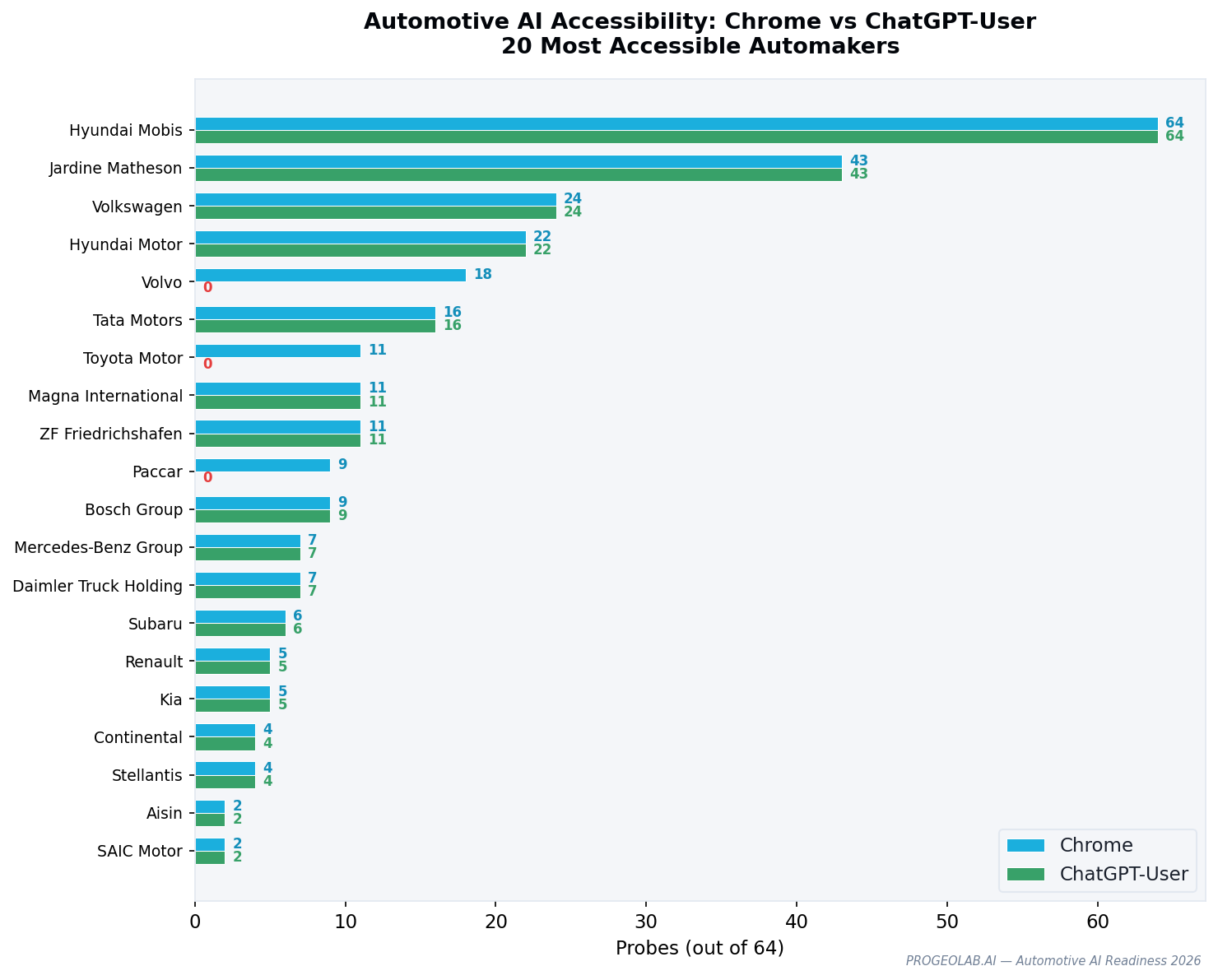
Three Fortune 500 automakers serve Chrome but block ChatGPT-User. Toyota (11/64 Chrome, 0/64 ChatGPT) is the most consequential — it is the world's largest automaker by volume and the most-asked-about car company on consumer AI assistants. The block means that when a car buyer asks ChatGPT to compare the Toyota Camry with the Honda Accord, neither company's current content is accessible, and the AI answers from training data for both.
Volvo (18/64 Chrome, 0/64 ChatGPT) runs Akamai WAF with AI-crawler filtering. Paccar (9/64 Chrome, 0/64 ChatGPT) has no detectable WAF but rejects ChatGPT-User at some other layer — possibly CDN-level.
The scorecard: top 15
| Rank | Company | Country | Score | Key signals |
|---|---|---|---|---|
| 1 | Volkswagen | Germany | 8 | llms.txt (198 links), JSON-LD, F5 BIG-IP |
| 2 | Subaru | Japan | 7 | llms.txt (100 links) |
| 3 | Hyundai Motor | South Korea | 5 | JSON-LD, 22/22 ChatGPT accessibility |
| 4 | BYD | China | 5 | JSON-LD, F5 BIG-IP permissive |
| 5 | Kia | South Korea | 5 | JSON-LD |
| 6 | Daimler Truck Holding | Germany | 5 | JSON-LD, F5 BIG-IP |
| 7 | Renault | France | 5 | JSON-LD, F5 BIG-IP |
| 8 | ZF Friedrichshafen | Germany | 5 | Tier-one supplier, accessible |
| 9 | Mercedes-Benz Group | Germany | 4 | JSON-LD, F5 BIG-IP |
| 10 | Bosch Group | Germany | 4 | JSON-LD |
| 11 | Continental | Germany | 4 | JSON-LD |
| 12 | Stellantis | Netherlands | 4 | JSON-LD |
| 13 | Toyota Motor | Japan | 2 | GEO gap: JSON-LD, F5 BIG-IP, ChatGPT 0/64 |
| 14 | Volvo | Sweden | 2 | GEO gap: JSON-LD, Akamai, ChatGPT 0/64 |
| 15 | Paccar | U.S. | 1 | GEO gap: ChatGPT 0/64 |
Twelve automakers rank zero or near-zero because of complete unreachability: Honda, Denso, Suzuki, Mazda (Japan), and Geely, CATL, Dongfeng, Chery, GAC, BAIC, China FAW (China) all produce connection errors across all four user agents. This reflects geographic infrastructure rather than AI-specific policy — same pattern seen in the Chinese bank cluster.
What's in the full report
- Complete 37-company scorecard with all dimensions per company
- Volkswagen case study: line-by-line analysis of the 198-link llms.txt
- Tesla case study: the three-layer WAF block, forensically traced
- Japanese OEM analysis: Toyota in the gap, Honda unreachable, Subaru overachieving
- Chinese automaker landscape: the accessibility collapse explained
- Tier-one supplier scorecard (Bosch, Continental, Denso, ZF, Magna, Aptiv)
- Recommendations: what VW did right, what Toyota could change in a week