llms.txt Adoption in the Fortune 500: 2.8% Real, 70.6% Reported
Published 2026-04-20 · PROGEOLAB Research
The llms.txt adoption paradox is the gap between what status-code scans report and what actually exists. Published adoption numbers for llms.txt across the Fortune 500 range from 60% to 75% depending on the scanner used. Body-validated adoption is 2.8%. The gap is not a measurement disagreement — it's a methodology failure. Every scanner that reports HTTP 200 without inspecting response bodies records soft-404 pages as real implementations.
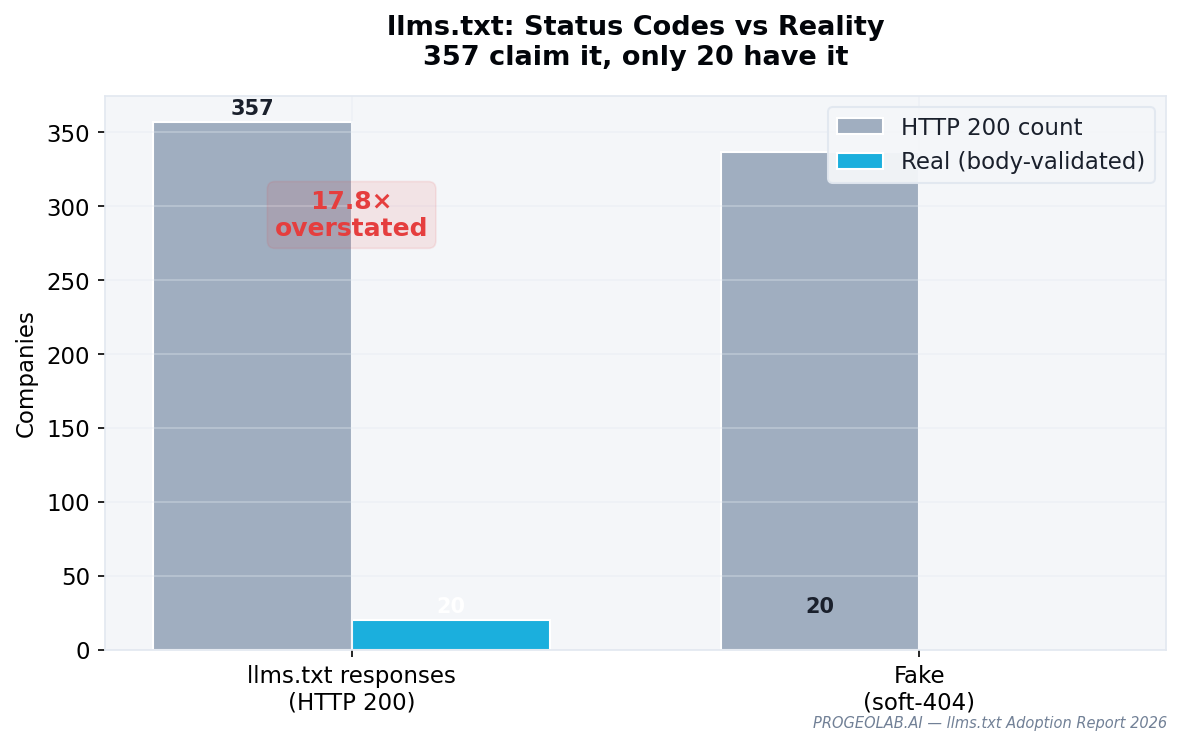
Of 500 Fortune 500 companies probed for /llms.txt:
- 353 returned HTTP 200 — the response is readable
- 14 contain real llms.txt content — body validation passes
- 339 are soft-404 pages — HTML templates, homepage redirects, or catch-all 200 responses
- 147 returned HTTP 404 or 5xx — no response
The 25× inflation factor (353 / 14 ≈ 25) is the most misleading number in current AI-standards reporting. Any guidance that tells enterprises "you're behind, 70% of peers have llms.txt" is factually wrong. The real competitive picture is "only 14 Fortune 500 companies have llms.txt — first-mover advantage is still available."
The 14 real implementations
The body-validated llms.txt files in the Fortune 500 cluster around five top performers (by link count):
| Company | Links | Note |
|---|---|---|
| Salesforce | 205 | Largest — but blocked to ChatGPT at WAF |
| Volkswagen | 198 | Largest accessible — case study |
| Dell Technologies | 131 | Multi-audience — enterprise, consumer, developer |
| Subaru | 100 | Lifestyle — models + dealers + brand stories |
| National Australia Bank | 61 | Largest in banking — all four divisions covered |
| 9 others | 20-60 | Target, HP, Nvidia, Repsol, Walmart, and five others |
Sector distribution
The 14 real implementations are concentrated in three sectors:
- Technology (5): Salesforce, Dell, HP, Nvidia, plus one
- Automotive (3): Volkswagen, Subaru, plus one
- Retail (2): Target, Walmart
- Banking + Energy + others (4): NAB, Repsol, and two others
Zero pharma companies have llms.txt. Zero insurance. Zero consumer goods. Zero heavy industry outside energy. The adopter profile skews toward content-rich businesses where curated AI discovery produces clear value — and away from regulated industries where cautious content-sharing defaults dominate.
Why the false 70% matters
AI-standards tooling that overstates adoption harms the standard itself. When CTOs hear "70% of the Fortune 500 has llms.txt," the competitive pressure to implement is absent — the bar is already met. The real 2.8% number creates the opposite pressure: implementation is both differentiating and inexpensive. Body validation — the difference between looking at HTTP status codes and reading the actual response — is what lets the measurement match reality.