Top 25 AI-Ready Fortune 500 Companies for 2026
Published 2026-04-20 · PROGEOLAB Research
The PROGEOLAB AI-Readiness Index scores all 500 companies in the Fortune Global 500 on their preparedness for AI-driven content discovery. Unlike search engine rankings — which measure output, i.e. where you appear in results — this index measures input: the signals your website provides to help AI answer engines access, understand, and accurately cite your content.
The index is derived from the April 2026 Fortune Global 500 AI Accessibility audit — 134,000 probe requests across 500 companies, four user agents (research bot, Googlebot, Chrome, ChatGPT-User), and raw response body analysis of robots.txt AI policies, llms.txt implementations, JSON-LD structured data, and security metadata.
This page is ungated: the full PDF, the full ranking, the data behind it, all free.
The scoring methodology
The AI-Readiness Index is a composite score across six dimensions, each scored independently on live probe data (no self-reported input, no vendor claims, no survey responses):
| Dimension | Signal | Points |
|---|---|---|
| AI Accessibility | ChatGPT-User returns ≥1 HTTP 200 | +3 |
| Browser Accessibility | Chrome returns ≥1 HTTP 200 | +1 |
| Content Curation | Real llms.txt file (body-validated) | +1 to +3 |
| Structured Data | JSON-LD on homepage | +1 |
| Entity Disambiguation | sameAs to Wikidata (+2) or Wikipedia (+1) | +1 to +2 |
| AI Bot Policy | robots.txt explicit Allow for AI bots | +1 to +2 |
| Security Metadata | security.txt present (RFC 9116) | +1 |
Maximum possible score: approximately 12 points (depending on llms.txt link count and sameAs target). Scores above 8 represent the most AI-ready companies; scores below 4 indicate no meaningful AI optimization.
The Top 25
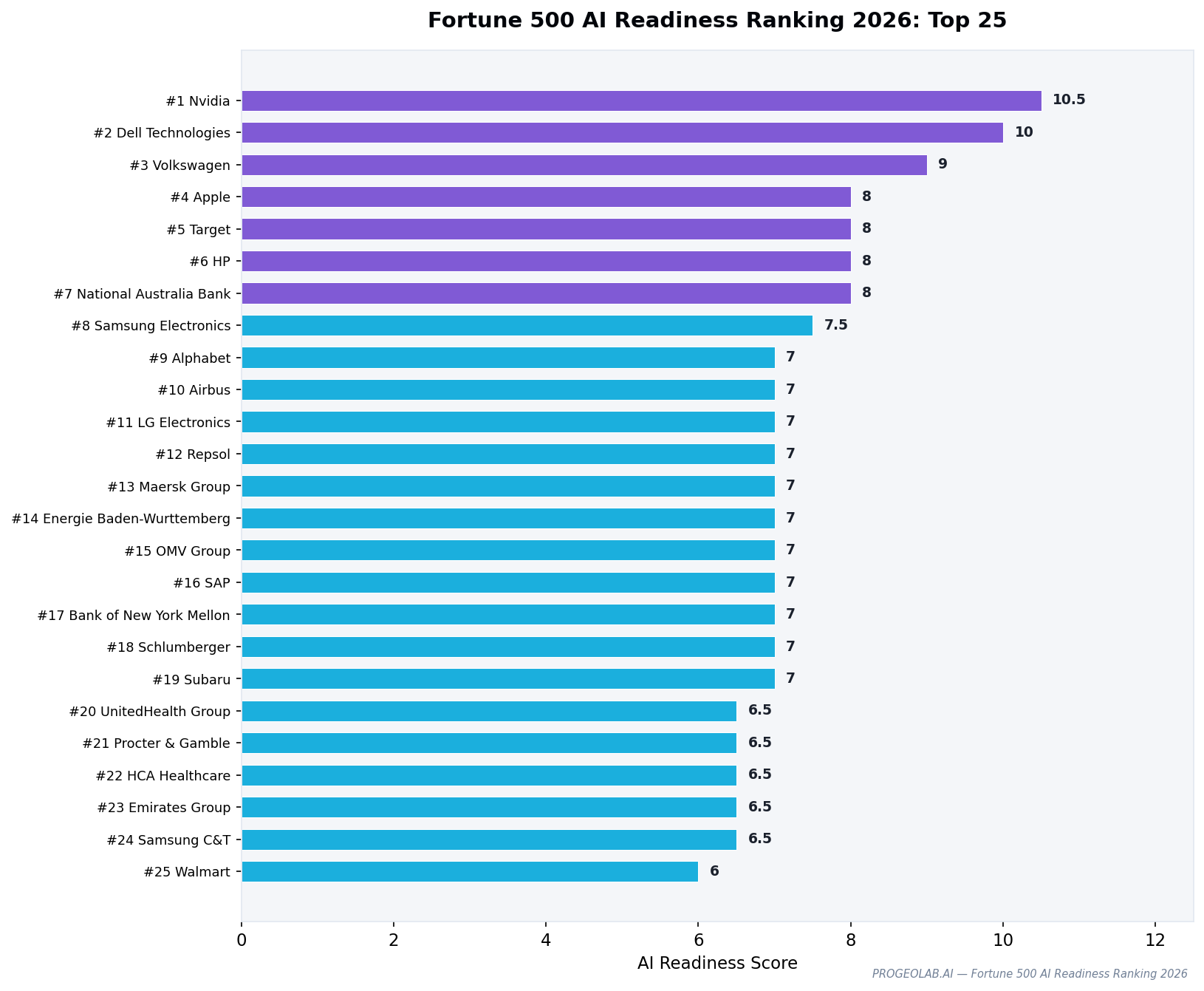
| Rank | Company | Country | Score | Key signals |
|---|---|---|---|---|
| 1 | Nvidia | U.S. | 10.5 | llms.txt (19), JSON-LD, sameAs, robots(17 AI bots) |
| 2 | Dell Technologies | U.S. | 10 | llms.txt (131), JSON-LD, robots(1) |
| 3 | Volkswagen | Germany | 9 | llms.txt (198), JSON-LD, security.txt |
| 4 | Apple | U.S. | 8 | JSON-LD, sameAs Wikidata (Q312), security.txt |
| 5 | Target | U.S. | 8 | llms.txt (54), JSON-LD |
| 6 | HP | U.S. | 8 | JSON-LD, robots(10 AI bots), security.txt |
| 7 | National Australia Bank | Australia | 8 | llms.txt (61), JSON-LD |
| 8 | Samsung Electronics | South Korea | 7.5 | JSON-LD, sameAs, robots(5 AI bots) |
| 9 | Alphabet | U.S. | 7 | JSON-LD, sameAs Wikipedia, security.txt |
| 10 | Airbus | Netherlands | 7 | JSON-LD, robots(1), security.txt |
| 11 | LG Electronics | South Korea | 7 | llms.txt (49), robots(1) |
| 12 | Repsol | Spain | 7 | llms.txt (44), JSON-LD, sameAs Wikidata (Q174747) |
| 13 | Maersk Group | Denmark | 7 | llms.txt (54), JSON-LD, Wikipedia, security.txt |
| 14 | Energie Baden-Wurttemberg | Germany | 7 | robots(11 AI bots), security.txt |
| 15 | OMV Group | Austria | 7 | JSON-LD, sameAs Wikipedia, security.txt |
| 16 | SAP | Germany | 7 | robots(13 AI bots), security.txt |
| 17 | Bank of New York Mellon | U.S. | 7 | JSON-LD, robots(8 AI bots) |
| 18 | Schlumberger | U.S. | 7 | JSON-LD, Wikipedia, security.txt |
| 19 | Subaru | Japan | 7 | llms.txt (100) |
| 20 | UnitedHealth Group | U.S. | 6.5 | JSON-LD, sameAs, security.txt |
| 21 | Procter & Gamble | U.S. | 6.5 | JSON-LD, sameAs, security.txt |
| 22 | HCA Healthcare | U.S. | 6.5 | JSON-LD, sameAs, security.txt |
| 23 | Emirates Group | UAE | 6.5 | JSON-LD, sameAs, security.txt |
| 24 | Samsung C&T | South Korea | 6.5 | JSON-LD, sameAs, security.txt |
| 25 | Walmart | U.S. | 6 | JSON-LD, security.txt |
#1 — Nvidia (10.5/12): the only company to pass everything
Nvidia tops the ranking by combining every dimension: ChatGPT accessibility (10 of 10 tested endpoints), a real llms.txt with 19 links, JSON-LD with sameAs attributes, the most comprehensive robots.txt AI policy in the Fortune 500 (17 AI bots named and allowed), and security.txt. Nvidia's robots.txt names GPTBot, ChatGPT-User, OAI-SearchBot, ClaudeBot (and variants), PerplexityBot (and variants), Google-Extended, Applebot-Extended, CCBot, Amazonbot, Bytespider, meta-externalagent, FacebookBot, Cohere-ai, and AI2Bot.
This is a company that builds AI infrastructure and practices what it sells. The contrast with the rest of the tech sector — which, per the flagship audit, blocks AI at 50% — is stark.
#2 — Dell Technologies (10/12): the quiet champion
Dell runs second with a 131-link llms.txt — the second-largest in the Fortune 500 after Volkswagen's 198. Dell's robots.txt is less expansive than Nvidia's (only one AI bot named explicitly), but the llms.txt volume and ChatGPT accessibility across 59 of 64 probed endpoints puts it second. Notable because Dell is not a company that markets itself as AI-first; its AI-readiness is a byproduct of general documentation quality.
#3 — Volkswagen (9/12): the automotive outlier
Volkswagen is the only Fortune 500 automotive company in the top 25, and its llms.txt — 198 links organized into five sections covering owner resources, media, investors, and product documentation — is the largest in the Fortune 500. Tesla, by comparison, scores 0 on the same index.
#4 — Apple (8/12): the entity-disambiguation standout
Apple is one of only three Fortune 500 companies with a sameAs link to Wikidata (Q312) — the property that lets AI answer engines canonically resolve which "Apple" a query means. Combined with JSON-LD, robots.txt AI policy, and security.txt, the 14 of 64 ChatGPT endpoints caps the score: Apple's site is accessible to AI but only on specific paths (the marketing pages, not product documentation).
Surprise entries outside tech
Five companies in the top 25 surprised our analysts:
- National Australia Bank (#7) — the highest-ranked financial services company, beating every US and European bank. A 61-link llms.txt plus JSON-LD puts it ahead of Goldman Sachs and JPMorgan (both in the visibility gap).
- Repsol (#12) — Spanish energy company with a 44-link llms.txt, JSON-LD, and the third Wikidata sameAs link in the Fortune 500 (Q174747). The only oil & gas company with a coherent AI-visibility posture.
- Energie Baden-Württemberg (#14) — German utility with 11 AI bots in robots.txt. Utilities aren't usually thought of as AI-forward; EnBW is an outlier.
- Schlumberger (#18) — US oilfield services company with JSON-LD plus sameAs to Wikipedia. Rare in the energy sector.
- Emirates Group (#23) — The only airline in the top 25; sameAs + security.txt on a large multi-brand domain.
Industry distribution: who makes the top 25
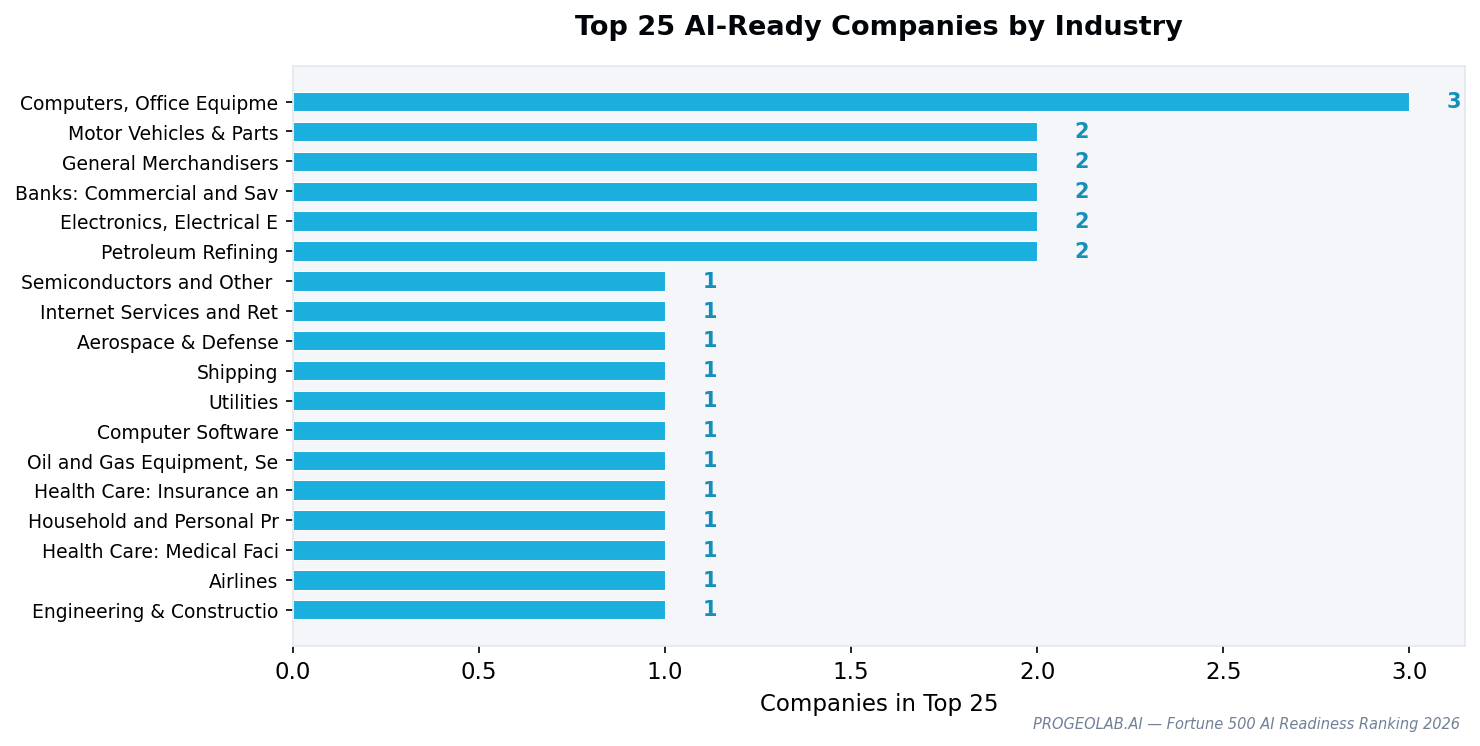
Despite the software-sector blocking pattern, tech infrastructure dominates the top 10 — Nvidia, Dell, Apple, HP, Samsung, Alphabet, SAP. The paradox: companies that build AI infrastructure invest heavily in AI visibility; companies that sell software products block it. Apple is the bridge case, optimizing for AI on marketing pages while keeping product documentation behind access controls.
Outside tech, automotive (Volkswagen, Subaru), banking (NAB, BNY Mellon), healthcare (UnitedHealth, HCA, P&G), energy (Repsol, OMV, EnBW, Schlumberger), and transport (Maersk, Airbus, Emirates) each place a company in the top 25. Retail is represented by Target and Walmart. Insurance, pharma, and chemicals — absent entirely.
The long tail: why 71% score below 5
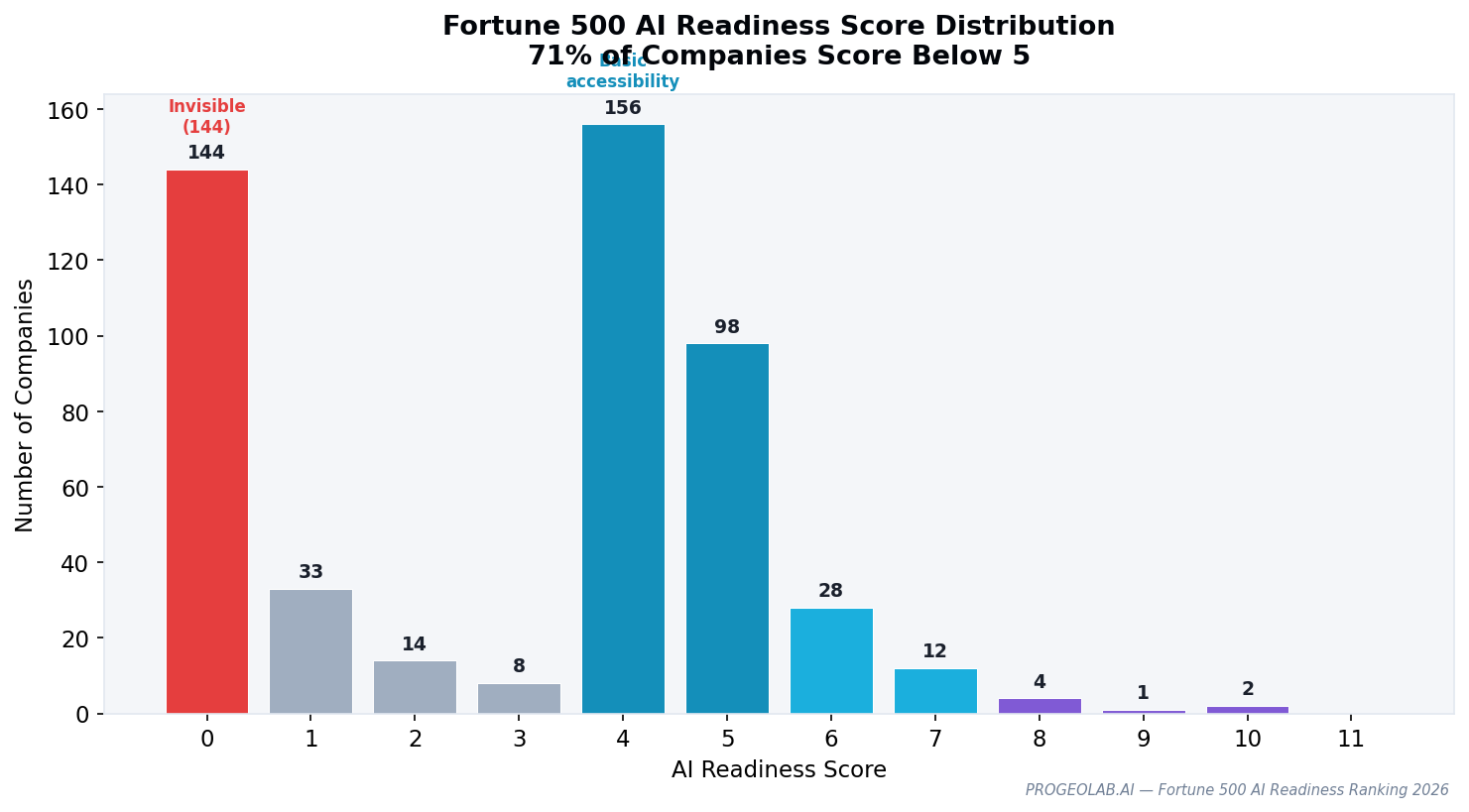
The score distribution is heavily weighted toward zero. The median company scores 3 points — meaning JSON-LD plus basic Chrome accessibility, nothing AI-specific. 71% of the Fortune 500 scores below 5. This is the long tail of enterprises that have made no meaningful AI-visibility investment: no llms.txt, no robots.txt AI policy, no sameAs to Wikidata, no four-user-agent response parity. Most of these sites are accessible to AI crawlers — but by accident of not blocking, not by design.
The GEO Maturity Model places these companies at Level 0 or Level 1, and the gap from Level 1 to Level 3 (the "structured visibility" threshold) requires five hours of targeted work per site — a roadmap documented in the pillar guide.
Full methodology and data
The ranking PDF (link below) includes every dimension's raw score per company, the full 500-company ranking, and the Python probe scripts used to generate the dataset. No form, no gate — this is open research.