Fortune 500 AI Accessibility by Country: The Geographic Map
Published 2026-04-20 · PROGEOLAB Research
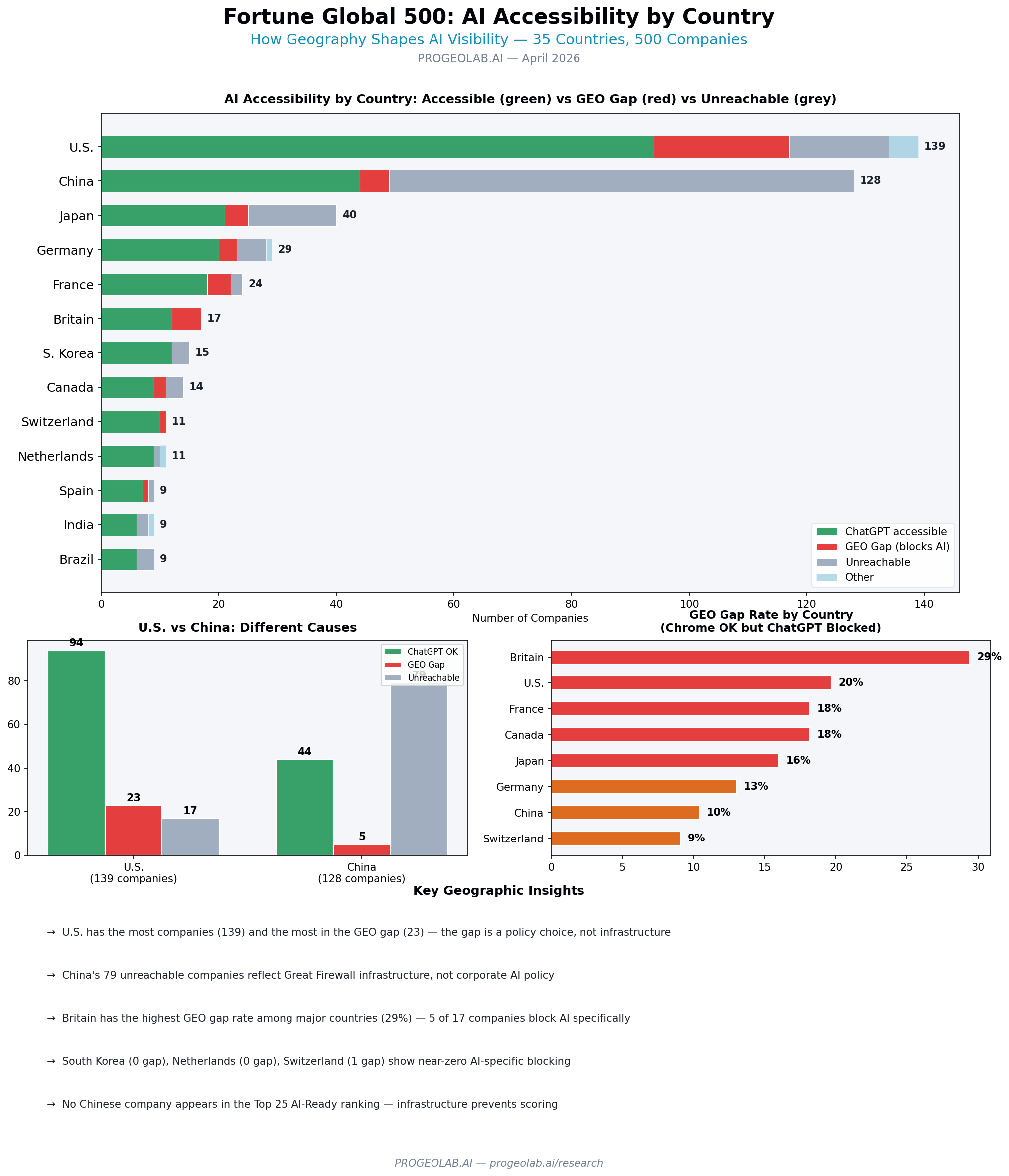
AI accessibility varies sharply by country — but not always for AI-specific reasons. This infographic maps Fortune 500 AI accessibility across 13 countries with enough sample size for reliable analysis, separating deliberate AI-blocking (US, Britain) from geographic infrastructure patterns (China, Japan).
The two types of country pattern
Deliberate AI-blocking shows up in the GEO gap rate — companies that serve Chrome but block ChatGPT. The US has 23 companies in the gap (19.7% rate among US Fortune 500). Britain has 5 in the gap out of 17 British Fortune 500 companies — a 29% rate, the highest of any country with meaningful sample size. Germany, France, and Japan sit in the 8-12% range. South Korea and the Netherlands show zero AI-specific blocking.
Geographic infrastructure blocking shows up in the unreachability rate — companies that no automated user agent can reach. China dominates this category with 128 unreachable Fortune 500 companies. This is not AI-specific blocking; Chinese corporate sites are optimized for domestic traffic and apply aggressive rejection to non-Chinese IP ranges. A Chinese site is equally inaccessible to ChatGPT-User, Googlebot, the research bot, and a datacenter-sourced Chrome probe. Japan shows a similar pattern among auto and tech companies.
The US's 43% share of the gap
Of the 53 companies in the overall GEO gap, 23 (43%) are US-headquartered. This is disproportionate — US companies are 117 of 500 Fortune 500 (23%). The overrepresentation reflects two patterns: US companies have more complex WAF configurations with more accumulated blocklist rules, and US companies are more likely to consciously block AI crawlers as a business decision (content licensing, data privacy, etc.).
The US gap includes most of the best-known blockers: Goldman Sachs, Bank of Montreal; Tesla, Paccar; Oracle, IBM, AT&T, Salesforce; Johnson & Johnson. The complete list is in the flagship research report.
South Korea's anomaly
The 6 South Korean Fortune 500 companies — Samsung, Hyundai, Kia, LG, SK Group, POSCO — show zero AI-specific blocking. Chrome and ChatGPT-User both reach what is reachable; nothing in the cohort blocks AI while serving browsers. The accessibility rates are not uniformly high (some Korean sites are hard to reach from European datacenters), but the AI-specific discrimination is absent.
Without speculating on causes, the dataset reports the pattern: South Korean enterprise WAFs do not, as of April 2026, discriminate between ChatGPT-User and Chrome. The Netherlands (4 companies) shows the same pattern.