Four User Agents, Four Different Fortune 500s: The Accessibility Infographic
Published 2026-04-20 · PROGEOLAB Research
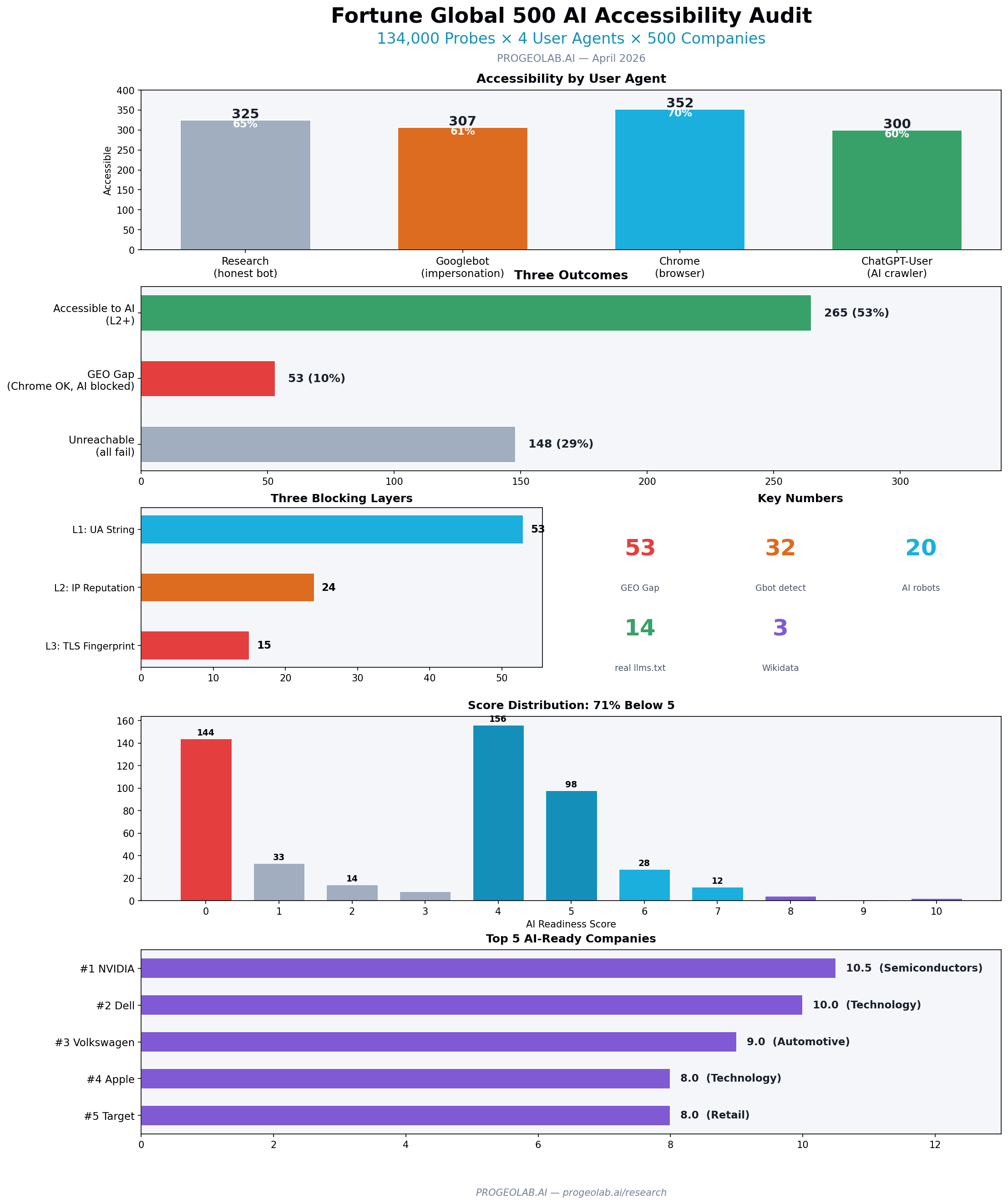
When the same Fortune 500 company is probed with four different user agent strings, it often returns four different results. This infographic visualizes the spread across 500 probes per user agent — 2,000 total requests — and the asymmetry between what Chrome browsers can access and what AI retrieval crawlers can access.
How to read it
The four bars represent accessibility rates per user agent. Chrome is the upper bound — a real-browser UA string from a datacenter IP. Research bot is the baseline — an honest, unknown crawler identifying itself. ChatGPT-User is the retrieval crawler that fetches pages when ChatGPT users click "browse" — the AI signal that matters most for live-query visibility.
The spread between Chrome (352) and ChatGPT-User (300) is the GEO Visibility Gap: 52 companies where browsers succeed but AI retrieval fails. Eight more company-level details (Alibaba accessible to ChatGPT-User but not Chrome, etc.) account for the difference between 52 and the headline 53.
Googlebot (307) sitting below the research bot (325) is the most counterintuitive finding. 32 Fortune 500 companies implement reverse-DNS verification for Googlebot and penalize impersonation attempts — so claiming to be Googlebot from a non-Google IP performs worse than admitting you're an unknown crawler.
Full methodology and the complete 134,000-probe dataset are in the flagship research report. The country-level companion visualization is available in the geographic infographic.